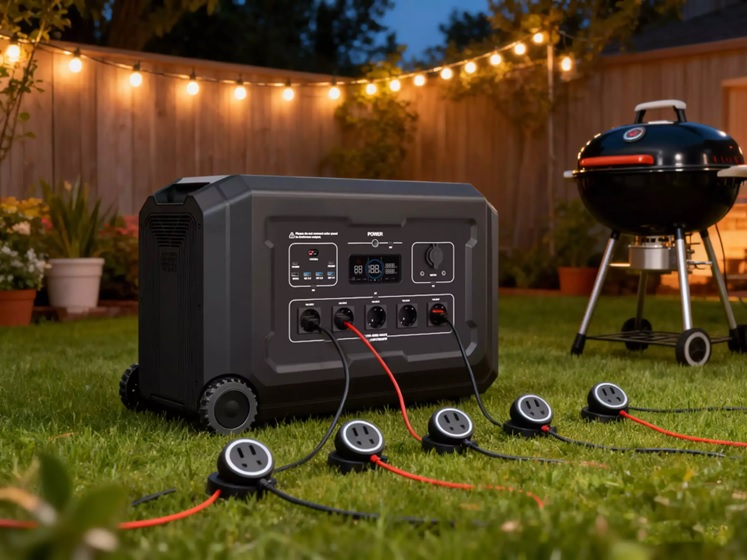
There is nothing like jumping in the car on a Friday night, heading into the woods, and leaving your emails alone. But even the most hardcore “unplug and disconnect” camper needs their cell phone charged for pictures, their headlamp charged for exploring, and a reliable power source to keep their cooler running so that their beer does not warm up by Saturday morning. This is why a Portable Power Station for Camping fits perfectly in the trunk alongside your tent and cooler.
If you have ever had a dead campfire and the last 3% of your phone battery while you are trying to find out when the rain will stop, you know why this product category has taken off. Your weekend camping trip does not require a full-sized solar station for your cabin but rather something compact that is reliable and easy to take with you so that you do not have to read the manual by flash light at 9 pm.
Why You Actually Need One
Many weekend warriors are under the impression that a couple of power banks is sufficient for their excursions. While that might be the case for the minimalist who only takes a tent and a sleeping bag, any camping trips requiring things like a camp fridge, string of lights, drone, CPAP machine, or children demanding to watch a movie before bed, will drain those power banks with alarming speed.
A proper power station can make all the difference. Instead of wrestling with a tangle of cords and having to worry about not wasting “battery juice”, you have a single unit which can power multiple devices at the same time, and in some cases offer both USB-A/USB-C ports and a standard AC outlet, allowing you to power the same devices you would at home. Some even allow you to power small appliances, meaning you can brew a hot beverage in the morning without lugging around a camping stove.
What to Look for Before You Buy
Not all power stations are created equal, and determining the appropriate one in your case depends mostly on the anticipated power needs. Below are the most critical factors that should influence your buying decision, including battery capacity, power ports, weight, and recharge options, among others.
- Battery capacity: The indicator that shows the energy stored in the power station, usually measured in watt-hours (Wh). Considering that a family camping trip may involve running the smartphone, a few LED lights, and a small radio, choosing a power station with a 300 to 600 Wh rating should be sufficient. However, if you have more devices and intend to use them continuously for more extended periods, going for a 1000 Wh power station would be more reasonable.
- Power output: The available ports that provide the electricity from the power station’s battery to your devices. Make sure to choose a power station that offers the appropriate ports (usually USB-A, USB-C, and DC-IN). Besides, most power stations come with an AC Inverter, so you should determine the wattage this port provides to power your devices. For instance, the 500W continuous power is enough to operate a coffee maker, but it will not be enough to run your hair dryer.
- Weight and portability: The more the battery capacity is, the heavier the power station is. Since most people need to carry it during their camping trips or adventures, it is critical to choose an option that is not too heavy while offering the required capacity. Ideally, your power station should weigh less than 40 pounds, and some of the latest power stations offer excellent power-to-weight ratios at under 15 pounds.
- Recharge options: Most power stations are charged via the wall outlet when you get home in the evening or before you leave the house for a trip. However, some power stations offer more versatility by allowing users to recharge them with solar panels or in-car chargers.
- Battery chemistry: LiFePO4 batteries have become an essential part of portable power stations due to their many benefits over other battery cells. Notably, LiFePO4 batteries offer higher discharge rates, meaning they are more powerful. Moreover, they are more resistant to high temperatures and provide a longer lifespan, especially when compared to the standard lithium-ion batteries.
Matching the Power Station to Your Trip
Weekend camping is a very broad concept, ranging from car camping to a minimalist backpacking adventure. Here are some guidelines per each category:
- Camping with the family: space is not an issue, so go for the 500-1000Wh station that will allow you to enjoy the comforts of home while on the trip. It will be able to power a mini-fridge, charge several devices, and run string lights or a fan.
- Minimalist camping: this type usually implies a solo or a two-people expedition. In this case, going for a power station in the 200-300Wh range is enough to keep phones, a headlamp, and a portable radio charged for two or three days.
- Overlanding or truck camping: if you are going to remote places and need to stay connected and comfortable while having no access to electricity, pairing a mid-size power station with a flexible solar panel is the way to go.
The Middle-of-the-Trip Reality Check
Here’s one aspect that’s not often discussed. Battery anxiety does not disappear with a power station; it just transforms into a different set of calculations. Instead of worrying about the battery in your phone or device, you have to worry about the battery in the power station.
A good way to think about this is to figure out what your combined power needs are. Figure out how much power the devices you want to power will consume in total, and then divide that number by your power station’s total output in watt-hours. A Camping Power Station can theoretically allow you to power a 5W LED camping lantern for 80-90 hours, but the same power station will be drained in less than 10 hours when powering a 50W mini-fridge. Performing these calculations beforehand will avoid the unpleasant situation of realizing on a Saturday afternoon that you have only 15% of the battery left while preparing to leave for a camping trip that will last two nights.
A Few Practical Tips From Experience
- Charge it up to full before every trip. Seems simple, but it is the number one mistake that people make. The battery on your power station will lose a surprising amount of charge when kept idle in the garage for a month.
- Never leave it in direct sunlight while not in active use. This can permanently damage the battery from the heat. Especially on a hot summer day when you have to keep it packed in your trunk.
- Test it out at home first. Plug in the devices you are bringing before you leave. You need to know how long they will actually last for, not what the manual says. This will save you from getting half way through your adventure with dead batteries.
- Remember to bring along the cords. It is very easy to forget them, and even easier to find your charging cord sitting on the counter when you get home 3 hours later.
- Think about bringing a small solar panel as a backup even on short trips. The weather is not always nice, and it is better to have an extra day to be out on the trail than to have to ration out your battery’s charge.
Final Thoughts
Weekend camping should be about kicking back and not worrying about heading back to the nearest ranger station to find an outlet. With the help of a power station, you can have the freedom and peace of mind that comes with knowing you can avoid the hassle of finding electricity and spend more time enjoying the great outdoors, whether you’re car camping with the whole family or just camping with a tent and some books. The right power station is easy to find because you can choose based on your specific needs and what you have to work with. Only think about what you need in a power station and what you don’t instead and you’ll be spending more time outside without the worry!